We had thought that 2807 might be on standby for the Christmas Cracker gala at the end of December. But it now looks as though 2807 will be running on both days.
Details on the GWSR web site at:
http://www.gwsr.com/planning-your-visit/2013-events-calendar/christmas-cracker.aspx
And the detailed timetable is at:
http://www.gwsr.com/media/270795/christmas%20cracker%202013.pdf
Let's hope it stays that way!
Steve

Sunday, 15 December 2013

Maintenance Update
Wednesday 11th
No new adverse comments against 2807, having operated on Saturday and Sunday last weekend. I say "adverse", because there is a comment that the nuts remain tight on the tender brake hangers. GWSR insist that the hangers must have split pins in the end of the suspension bolts such that there is no chance of the nuts coming loose and dropping off. meanwhile, they have to be inspected weekly. They're fine!
Gilbert, John-G, Colin & Ann were working on the siphon. I was finishing off some boot scrapers. Then I decided to attack some of the rail chairs that are heavily contaminated with ancient grease. I managed to chisel it off 5 during the afternoon, and then apply the rotary wire brush to get rid of the last bits. These, of course, got their own back on me by showering my face, coat and shoes with oily black specs.
Saturday 14th
Rain was threatened for the afternoon, so I started on cleaning rail chairs. However, David was already underneath 2807 doing more welding to the new ashpan bottom. The loco had been used last weekend, and all was well. David wanted to add more weld to the new lower portion on the outside. This is extremely unpleasant, because he had to stand in the pit beneath the loco and weld upwards. Furthermore, he added a strengthening angle-iron across the edge of the damper door opening's bottom to reduce the likelihood of the base bowing (which it had before). This was an all-day task for David, with Gilbert initially giving a helping had (or moral support).
Bruce joined me, and together we cleaned up 14 rail chairs ready to convert 12 of them into boot scrapers. The other two? Well, beneath the inch-thick grease on one of them was an 1899 Midland Railway chair which I thought we might sell as-is via eBay, or something; the other is a Swindon-made GWR chair of some age (not sure of date of manufacture, as it only says GWR & SN & 92).
There was a huge pile of "raw" chairs, some covered in grease and most with bolts through them (that needed cutting off). John decided to tackle this pile, and with Gilbert helping, every one of the forty-plus chairs was de-bolted and stacked neatly ready for prepping. What a fantastic effort.
We also did some tidying up around our TPO (and I half-inched a July 1942 LMS chair from a nearby sleeper!).
2807 is in service on Sunday - this is her last official service. She may then be in service on 29 & 30 December, but might just be held as standby loco. 2014 timetable is available on GWSR web site:
http://www.gwsr.com/planning-your-visit/2014-timetable.aspx
Roger
No new adverse comments against 2807, having operated on Saturday and Sunday last weekend. I say "adverse", because there is a comment that the nuts remain tight on the tender brake hangers. GWSR insist that the hangers must have split pins in the end of the suspension bolts such that there is no chance of the nuts coming loose and dropping off. meanwhile, they have to be inspected weekly. They're fine!
Gilbert, John-G, Colin & Ann were working on the siphon. I was finishing off some boot scrapers. Then I decided to attack some of the rail chairs that are heavily contaminated with ancient grease. I managed to chisel it off 5 during the afternoon, and then apply the rotary wire brush to get rid of the last bits. These, of course, got their own back on me by showering my face, coat and shoes with oily black specs.
Saturday 14th
Rain was threatened for the afternoon, so I started on cleaning rail chairs. However, David was already underneath 2807 doing more welding to the new ashpan bottom. The loco had been used last weekend, and all was well. David wanted to add more weld to the new lower portion on the outside. This is extremely unpleasant, because he had to stand in the pit beneath the loco and weld upwards. Furthermore, he added a strengthening angle-iron across the edge of the damper door opening's bottom to reduce the likelihood of the base bowing (which it had before). This was an all-day task for David, with Gilbert initially giving a helping had (or moral support).
Bruce joined me, and together we cleaned up 14 rail chairs ready to convert 12 of them into boot scrapers. The other two? Well, beneath the inch-thick grease on one of them was an 1899 Midland Railway chair which I thought we might sell as-is via eBay, or something; the other is a Swindon-made GWR chair of some age (not sure of date of manufacture, as it only says GWR & SN & 92).
There was a huge pile of "raw" chairs, some covered in grease and most with bolts through them (that needed cutting off). John decided to tackle this pile, and with Gilbert helping, every one of the forty-plus chairs was de-bolted and stacked neatly ready for prepping. What a fantastic effort.
We also did some tidying up around our TPO (and I half-inched a July 1942 LMS chair from a nearby sleeper!).
2807 is in service on Sunday - this is her last official service. She may then be in service on 29 & 30 December, but might just be held as standby loco. 2014 timetable is available on GWSR web site:
http://www.gwsr.com/planning-your-visit/2014-timetable.aspx
Roger
Saturday, 7 December 2013
Maintenance Update
Wednesday 4th
Geof has been taking it easy, helping Fred & Ray restoring the siphon van. Geof has been painting (which is considerably better than panting, which he had been doing when working on the loco lately!).
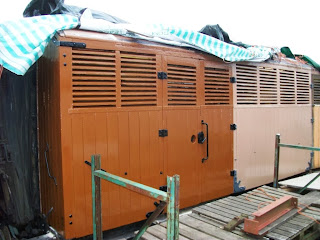
There was a bit of a rush on, as 2807 was to be in service this weekend ... and the ash pan was not yet completed! So, David settled down inside the firebox and spent all day welding in the new sections, especially the damper door surround (when I left, the damper door was still not fitted).


Gilbert was under the loco (in the pit) assisting David, and preparing to refit the damper door.
Bruce began by acting as "gopher". For example, he cut off part of the head of two bolts, which otherwise would not fit into their holes in the ash pan due to being too close to something that was in the way. Thereafter, Bruce assisted the boot scraper cause by cutting off bolts from some of the chairs in the pile.

John Mayell popped in, just to buy another boot scraper (a black one, this time). He was working on P-Way, so couldn't stay.
I applied an enamel coat to the stock of part-painted chairs, building up the supply while the going was good.
Sat 7th
I was delighted (relieved!) to see 2807 at the head of the coaching stock as I arrived at Todders this morning. Also, she sounded great when she stormed off down the line at 10.30 (presumably straight through to Cheltenham to pick up the first load of Santa Special people).
Understandably, I was the only one working (in our group) at Toddington today. Gilbert did pop in for a cuppa - he really wanted to speak to Rod in the workshop, but no sign of Rod. Gil said that he, Fred, Colin & Ann were all working on the siphon at Winchcombe. Later, Stu popped in to return sales stock, he having spent the morning at Toddington Village Hall for their Xmas sales day.
So, I painted the lettering on a multitude of chairs and then stained 9 brushes in anticipation. Tim Pickthorn was using our TPO to show a couple of chaps how the buck-eye coupling works (I heard someone fiddling outside & went for a butcher's). Mark Young was hurtling around in the fork-lift truck, clearing up anything that didn't look as though the owner would miss it - there is a small quantity of staging that belongs to us that could do with moving round the other side of the TPO and tidying.
2807 will be in service on Sunday 8th Dec, and then again on Sunday 15th Dec.
Roger

Geof has been taking it easy, helping Fred & Ray restoring the siphon van. Geof has been painting (which is considerably better than panting, which he had been doing when working on the loco lately!).

There was a bit of a rush on, as 2807 was to be in service this weekend ... and the ash pan was not yet completed! So, David settled down inside the firebox and spent all day welding in the new sections, especially the damper door surround (when I left, the damper door was still not fitted).


Gilbert was under the loco (in the pit) assisting David, and preparing to refit the damper door.
Bruce began by acting as "gopher". For example, he cut off part of the head of two bolts, which otherwise would not fit into their holes in the ash pan due to being too close to something that was in the way. Thereafter, Bruce assisted the boot scraper cause by cutting off bolts from some of the chairs in the pile.

John Mayell popped in, just to buy another boot scraper (a black one, this time). He was working on P-Way, so couldn't stay.
I applied an enamel coat to the stock of part-painted chairs, building up the supply while the going was good.
Sat 7th
I was delighted (relieved!) to see 2807 at the head of the coaching stock as I arrived at Todders this morning. Also, she sounded great when she stormed off down the line at 10.30 (presumably straight through to Cheltenham to pick up the first load of Santa Special people).
Understandably, I was the only one working (in our group) at Toddington today. Gilbert did pop in for a cuppa - he really wanted to speak to Rod in the workshop, but no sign of Rod. Gil said that he, Fred, Colin & Ann were all working on the siphon at Winchcombe. Later, Stu popped in to return sales stock, he having spent the morning at Toddington Village Hall for their Xmas sales day.
So, I painted the lettering on a multitude of chairs and then stained 9 brushes in anticipation. Tim Pickthorn was using our TPO to show a couple of chaps how the buck-eye coupling works (I heard someone fiddling outside & went for a butcher's). Mark Young was hurtling around in the fork-lift truck, clearing up anything that didn't look as though the owner would miss it - there is a small quantity of staging that belongs to us that could do with moving round the other side of the TPO and tidying.
2807 will be in service on Sunday 8th Dec, and then again on Sunday 15th Dec.
Roger
Sunday, 1 December 2013
Maintenance Update
Sat 30th
I arrived earlier than normal, at around 9:30. But still not early enough to beat David. David was already setting up to start welding the ash pan. Gilbert and Bruce arrived shortly afterwards, and a little later we were joined by Mike.

It was a beautiful sunny day, a little chilly, but still the sort of day when it's a pleasure to be outside. Which is fortunate because 2807 is over the pit in front of the David Page shed.
For the first few hours we were all involved in work on the ash pan, but also periodically distracted by a yard shunt that was going on. The crane that has been next to the TPO for some years is no longer there. It has been replaced by the Cotswold Diesel (owners of the 45 and 26) coach. Of course, while the crane required no specific access, we have become accustomed to storing our 'stuff' (mainly rail chairs awaiting processing into boot scrapers) against it. This changes now because the diesel guys will need access to their coach, and so some of the chairs had to be moved, with possibly more to be moved at a later date. In addition to this our water supply is shared with the diesel guys' coach, and so this had to be changed as well.

It seems that some of the reason for the move around is to make space for the arrival of un-restored 28XX no. 2874. Apparently she will be taking up residence just about in the position that 2807 occupied for so many years. That's going to be a bit odd for those of us who were involved at that time. If we give them a blue plastic bag to put on the chimney, which was a 'feature' of 2807 for many years, then it will feel very weird.
Anyway, back to Saturday,Gilbert checked the loco roster and discovered that 2807 is due to be in service on Saturday 7th and Sunday 8th. This added an element of urgency to proceedings!
Bruce was preparing the ash pan plate for the front of the rear section - the plate that the damper door is attached to.

Mike and I turned our attention to completing the reinstatement of the valve cylinder front ends. The RHS was pretty much there. We'd fitted the front cover and rod cover a few weeks ago (16th). Since then the LHS has been measured and rectified, and the front covers loosely fitted. Mike and I fitted the RHS front cladding and insulation. A tricky job in the confined space available. Then we tightened the LHS front covers. This brought us to lunch time.
After lunch, unfortunately Mike had to leave, as he'd been in early in his role as loco cleaner. So I fitted the LHS cladding and insulation. Then Bruce and I fitted the running plates, flap, and lamp bracket - two man jobs because of the round-headed bolts.
David and Gilbert continued with the ash pan work. The rear plate was welded in and then the base lowered back into position. It had been lifted to the front part of the firebox, as it was felt if we removed it completely then it might not be possible to get it back in again with the back in place. The floor was welded across the back edge, securing it to the back section. It now remains to weld the sides of the base, then weld the door plate in position and reinstate the door and operating lever. David will be coming on Wednesday to complete the welding for the loco to be in service on Saturday. The air extraction system, purchased by us on behalf of the railway proved very effective.
And finally - Christmas is coming!

Steve
I arrived earlier than normal, at around 9:30. But still not early enough to beat David. David was already setting up to start welding the ash pan. Gilbert and Bruce arrived shortly afterwards, and a little later we were joined by Mike.

It was a beautiful sunny day, a little chilly, but still the sort of day when it's a pleasure to be outside. Which is fortunate because 2807 is over the pit in front of the David Page shed.
For the first few hours we were all involved in work on the ash pan, but also periodically distracted by a yard shunt that was going on. The crane that has been next to the TPO for some years is no longer there. It has been replaced by the Cotswold Diesel (owners of the 45 and 26) coach. Of course, while the crane required no specific access, we have become accustomed to storing our 'stuff' (mainly rail chairs awaiting processing into boot scrapers) against it. This changes now because the diesel guys will need access to their coach, and so some of the chairs had to be moved, with possibly more to be moved at a later date. In addition to this our water supply is shared with the diesel guys' coach, and so this had to be changed as well.

It seems that some of the reason for the move around is to make space for the arrival of un-restored 28XX no. 2874. Apparently she will be taking up residence just about in the position that 2807 occupied for so many years. That's going to be a bit odd for those of us who were involved at that time. If we give them a blue plastic bag to put on the chimney, which was a 'feature' of 2807 for many years, then it will feel very weird.
Anyway, back to Saturday,Gilbert checked the loco roster and discovered that 2807 is due to be in service on Saturday 7th and Sunday 8th. This added an element of urgency to proceedings!
Bruce was preparing the ash pan plate for the front of the rear section - the plate that the damper door is attached to.

Mike and I turned our attention to completing the reinstatement of the valve cylinder front ends. The RHS was pretty much there. We'd fitted the front cover and rod cover a few weeks ago (16th). Since then the LHS has been measured and rectified, and the front covers loosely fitted. Mike and I fitted the RHS front cladding and insulation. A tricky job in the confined space available. Then we tightened the LHS front covers. This brought us to lunch time.
After lunch, unfortunately Mike had to leave, as he'd been in early in his role as loco cleaner. So I fitted the LHS cladding and insulation. Then Bruce and I fitted the running plates, flap, and lamp bracket - two man jobs because of the round-headed bolts.
David and Gilbert continued with the ash pan work. The rear plate was welded in and then the base lowered back into position. It had been lifted to the front part of the firebox, as it was felt if we removed it completely then it might not be possible to get it back in again with the back in place. The floor was welded across the back edge, securing it to the back section. It now remains to weld the sides of the base, then weld the door plate in position and reinstate the door and operating lever. David will be coming on Wednesday to complete the welding for the loco to be in service on Saturday. The air extraction system, purchased by us on behalf of the railway proved very effective.
And finally - Christmas is coming!

Steve
Thursday, 21 November 2013
Maintenance Update
Monday 18th
I popped in to the TPO and slapped Deproma anti-rust on some bottoms, and GWR green enamel on 4 tops.
Tuesday 19th
Today the sun shone, and I could see what a pig's ear I'd made of the tops yesterday! Had to re-paint them. Had hoped to do the lettering with a view to finishing them off on Weds!
Wednesday 20th
The day began with rain and hail. Geof pressed on for a while outside. Bruce decided to paint some chairs inside! Fred brought Gilbert, and tea break was declared. Fred then returned to the siphon at Winchcombe, where he had abandoned Ray.
Bruce completed 3 BR chairs in red Deproma, ready to become Crimson Lake. Then he focussed on the vacuum retaining valve that Carpo thought was sticking up. Bruce keeps making sealing rings for the valve piston, testing out ideas and trying to get the ring to be a perfect circle and not stick in its cylinder. Also he has an idea of making a push rod for inside the cylinder so that you can demonstrate that the piston is stuck up ... or is not! This is Bruce's homework.
Geof pointed out that, since the damper door is being lowered, but not increased in depth, could we please remove the angle iron welded across its inside face, because it makes it very awkward to get the ash rake in through the door, as the angle restricts the opening. I'm sure I'd mentioned it before, but this time notice was taken! Bruce cut it off. He also found a smaller angle that could be welded in its place with considerably less interference for the fireman. The point was expressed that some of our team would benefit from experiencing a day of firing and clearing out the ash, to learn some of the idiosyncrasies of our loco first-hand.
Gil & Geof re-measured the LHS cylinder valve rod, and decided that it is feasible just to re-bush the front cover. All else is within tolerances. This saves us removing the whole assembly - just the front cover. Bruce joined in with the discussion about actual sizes versus sizes on the diagrams that we have. As usual, the diagrams do not entirely reflect what we have on the loco. G&G then replaced the running boards on the LHS and also took the remnants of the ash pan bottom to the skip.
I had busied myself with you-know-whats, painting 9 tops in Deproma, lettering the 4 that I re-painted yesterday, and finishing off one boot scraper that is ordered.
The loco has had 59 of its 60 steamings, so there is no guarantee she will be out during December, though rumour (i.e. Geof) had it that Adey is planning 5 steamings for her. Oh, BTW, the Turk has two more broken springs, I hear!
TTFN
Roger
I popped in to the TPO and slapped Deproma anti-rust on some bottoms, and GWR green enamel on 4 tops.
Tuesday 19th
Today the sun shone, and I could see what a pig's ear I'd made of the tops yesterday! Had to re-paint them. Had hoped to do the lettering with a view to finishing them off on Weds!
Wednesday 20th
The day began with rain and hail. Geof pressed on for a while outside. Bruce decided to paint some chairs inside! Fred brought Gilbert, and tea break was declared. Fred then returned to the siphon at Winchcombe, where he had abandoned Ray.
Bruce completed 3 BR chairs in red Deproma, ready to become Crimson Lake. Then he focussed on the vacuum retaining valve that Carpo thought was sticking up. Bruce keeps making sealing rings for the valve piston, testing out ideas and trying to get the ring to be a perfect circle and not stick in its cylinder. Also he has an idea of making a push rod for inside the cylinder so that you can demonstrate that the piston is stuck up ... or is not! This is Bruce's homework.
Geof pointed out that, since the damper door is being lowered, but not increased in depth, could we please remove the angle iron welded across its inside face, because it makes it very awkward to get the ash rake in through the door, as the angle restricts the opening. I'm sure I'd mentioned it before, but this time notice was taken! Bruce cut it off. He also found a smaller angle that could be welded in its place with considerably less interference for the fireman. The point was expressed that some of our team would benefit from experiencing a day of firing and clearing out the ash, to learn some of the idiosyncrasies of our loco first-hand.
Gil & Geof re-measured the LHS cylinder valve rod, and decided that it is feasible just to re-bush the front cover. All else is within tolerances. This saves us removing the whole assembly - just the front cover. Bruce joined in with the discussion about actual sizes versus sizes on the diagrams that we have. As usual, the diagrams do not entirely reflect what we have on the loco. G&G then replaced the running boards on the LHS and also took the remnants of the ash pan bottom to the skip.
I had busied myself with you-know-whats, painting 9 tops in Deproma, lettering the 4 that I re-painted yesterday, and finishing off one boot scraper that is ordered.
The loco has had 59 of its 60 steamings, so there is no guarantee she will be out during December, though rumour (i.e. Geof) had it that Adey is planning 5 steamings for her. Oh, BTW, the Turk has two more broken springs, I hear!
TTFN
Roger
Sunday, 17 November 2013
Maintenance Update
Weds 13th
By the time I arrived, David, Gil & Bruce were hard at it. GWSR Loco Dept had purchased a sucky/blowy-thing so that when David is welding inside the ash pan, it will maintain a supply of fresh air (and suck/blow out the welding fumes). As with any new toy, the chaps had unwrapped it and had a play - Christmas came early!
David & Bruce worked on the damper door and its linkage. The old door needed a bit more straightening, and then a bit more stiffening, followed by the cast steel bracing being bolted back on. David had cut out various bits of metal for the new linkage - it needed lengthening and a minor diversion inserting. This he welded up, cleaned and primed. Which reminds me - we need new primer.

Gilbert, aided by Mike, concentrated on the ash pan. Specifically, cutting out the bottom panel that once was the infamous hopper door. The latter had been welded in place, having insisted on drooping during service and letting air in & hot ash out. Finally, Gil & David were deciding how & where to make the "big cut" to remove the lower half of the rear section of ash pan. Fred was last seen toddling round with a spirit level in his hand - serves him right for asking, probably!

Geof arrived after lunch (after the doctor's) and took many measurements of the cylinder valve rods and valve diameters. He pronounced that the rod had worn 25 thou' (which is within the 30 thou' tolerance) and the valves themselves were also within tolerance limits. Therefore, no work is required to be done on them (other than to fit them back on the loco!).
Me? Well, you can probably guess: I cleaned 5 BR(W) rail chairs plus 2 rather filthy GNR chairs. John Mayell (P.Way) popped in to collect (and pay for) a BR boot scraper in crimson that he had ordered. My neighbour Dorothy has ordered one as a Christmas present; she doesn't know for whom, yet, but they are so unique that someone who thinks he has got everything is about to find out that he hadn't!
Sat 16th
Initially, John T, Gil & myself prepared the workspace for cutting off the base of the ash pan. This was the proverbial situation of sitting on a branch and cutting it off !!! Gil was to be inside the ash pan, cutting out the bottom ... while standing on it. :-))
So, we acquired some pallets and built a base that supported the ash pan such that when it fell, it would not drop more than the odd millimetre. It was also time to test the sucky/blowy thing, to try to maintain fresh air in the ash pan for Gilbert. John got volunteered to be chief gopher and nurse maid (keeping an eye on Gil while he worked inside the firebox cutting off the lower portion of the ash pan).


Bruce came with some ideas about testing a valve in the braking system that Carpo was convinced was sticking. Bruce is convinced that it isn't, and so devised some ways of testing it. We can't do that unless in steam, though.
Geof and Steve tackled the cylinder valves, with Bruce joining them. The RHS rod and valve heads are all within tolerances, so they simply fitted the whole shaft back in place. In an effort to save effort (!) Geof attempted to measure the LHS without extracting the whole thing. This appears to show that the LHS rod is well outside of tolerance. However, it was not easy to measure, so it will have to come out next Wednesday and be checked properly. Geof, Steve and Bruce started to dismantle the LHS valve assembly to give a 'flying start' to Wednesday.
Apart from assisting with pallets, and later with carrying the RHS valve assembly back to the loco, my focus was once more on building up a stock of boot scrapers in case anyone wants one (or two) for Christmas. I aim to have enough to tide us through December, and thereafter we have three months in which the loco will be at Tyseley, so I hope then to have more help getting boot scrapers ready for next season.
Roger
By the time I arrived, David, Gil & Bruce were hard at it. GWSR Loco Dept had purchased a sucky/blowy-thing so that when David is welding inside the ash pan, it will maintain a supply of fresh air (and suck/blow out the welding fumes). As with any new toy, the chaps had unwrapped it and had a play - Christmas came early!
David & Bruce worked on the damper door and its linkage. The old door needed a bit more straightening, and then a bit more stiffening, followed by the cast steel bracing being bolted back on. David had cut out various bits of metal for the new linkage - it needed lengthening and a minor diversion inserting. This he welded up, cleaned and primed. Which reminds me - we need new primer.

Gilbert, aided by Mike, concentrated on the ash pan. Specifically, cutting out the bottom panel that once was the infamous hopper door. The latter had been welded in place, having insisted on drooping during service and letting air in & hot ash out. Finally, Gil & David were deciding how & where to make the "big cut" to remove the lower half of the rear section of ash pan. Fred was last seen toddling round with a spirit level in his hand - serves him right for asking, probably!

Geof arrived after lunch (after the doctor's) and took many measurements of the cylinder valve rods and valve diameters. He pronounced that the rod had worn 25 thou' (which is within the 30 thou' tolerance) and the valves themselves were also within tolerance limits. Therefore, no work is required to be done on them (other than to fit them back on the loco!).
Me? Well, you can probably guess: I cleaned 5 BR(W) rail chairs plus 2 rather filthy GNR chairs. John Mayell (P.Way) popped in to collect (and pay for) a BR boot scraper in crimson that he had ordered. My neighbour Dorothy has ordered one as a Christmas present; she doesn't know for whom, yet, but they are so unique that someone who thinks he has got everything is about to find out that he hadn't!
Sat 16th
Initially, John T, Gil & myself prepared the workspace for cutting off the base of the ash pan. This was the proverbial situation of sitting on a branch and cutting it off !!! Gil was to be inside the ash pan, cutting out the bottom ... while standing on it. :-))
So, we acquired some pallets and built a base that supported the ash pan such that when it fell, it would not drop more than the odd millimetre. It was also time to test the sucky/blowy thing, to try to maintain fresh air in the ash pan for Gilbert. John got volunteered to be chief gopher and nurse maid (keeping an eye on Gil while he worked inside the firebox cutting off the lower portion of the ash pan).


Bruce came with some ideas about testing a valve in the braking system that Carpo was convinced was sticking. Bruce is convinced that it isn't, and so devised some ways of testing it. We can't do that unless in steam, though.
Geof and Steve tackled the cylinder valves, with Bruce joining them. The RHS rod and valve heads are all within tolerances, so they simply fitted the whole shaft back in place. In an effort to save effort (!) Geof attempted to measure the LHS without extracting the whole thing. This appears to show that the LHS rod is well outside of tolerance. However, it was not easy to measure, so it will have to come out next Wednesday and be checked properly. Geof, Steve and Bruce started to dismantle the LHS valve assembly to give a 'flying start' to Wednesday.
Apart from assisting with pallets, and later with carrying the RHS valve assembly back to the loco, my focus was once more on building up a stock of boot scrapers in case anyone wants one (or two) for Christmas. I aim to have enough to tide us through December, and thereafter we have three months in which the loco will be at Tyseley, so I hope then to have more help getting boot scrapers ready for next season.
Roger
Saturday, 9 November 2013
Maintenance Update
Weds. 6th Nov
Gilbert attacked the ash pan, and Bruce initially offered help. The first task was to remove the damper door so that it could be used to verify the new-cut metal. This proved to be quite a challenge. Two chaps from the Loco Dept joined in and helped Gil. Fire bars had to be removed so that Gil could get inside the firebox, standing in the front section, leaning over where the axle passes beneath, and working (almost upside down) in the rear section. It was impossible to undo nuts & bolts, so Gil attacked them with an angle grinder.
The portable lamp threw a wobbly, as two wires decided they'd had enough of being bent. I examined the cable, and discovered that it had not been assembled "cleverly". It was easy enough to cut off the dead wire, thread the cable properly and re-assemble it.
3/4 the way through the last bolt, and Gil's angle grinder died. Raiding the Loco Dept tool store, he found another. Plugged it in ... no sign of life! Why do people put away dead tools, instead of informing someone and getting them fixed??? Gil found a third one, and that did work.
Meanwhile, I started cleaning rail chairs, but rain soon started. This results in the rust & oil combining into a brown soup on the chairs as the needle gun pounds the mixture into a paste. Also, Gilbert had nicked my angle grinder (see above) so I couldn't finish off the prep anyway. As the rain increased, I decided to give up.
Bruce had wisely moved inside and was painting chairs prepared last weekend. He could only spare the morning at Todders, and disappeared at lunchtime. I painted brushes until lunch. Thereafter, there was little I could do, so I went home, too. In a way, it was lucky that I did because a courier arrived at my house with new wire brush discs for us.
Fri. 8th
I did lettering on rail chairs and then dismantled our dead angle grinder. One of the carbon brushes had died. I located spares on t'internet and order a set.
Sat. 9th
Lots of people responded to my email asking for help for Gilbert, as he was supposed to be replacing the lower rear section of the ash pan and remove the cylinder valve pistons - these need to be completed by end November.
Because rain was threatened, I arrived early and attacked some GWR rail chairs, cleaning three before the rain set in leading to me making more soup.
David arrived did a bit of welding. Later, he made a short section of rod for the new position of the damper door. The door will be a couple of inches lower to make it easier to clear out ash. Needless to say, the existing rod then fouled some pipe work, so this by-pass had to be made to divert the rod round the pipe. Bruce, John G, John T, Geof soon followed. Despite the rain, most people started tackling the ash pan and valves. Fortunately, the rain stopped at lunchtime, which made it more pleasant to continue.
The rear damper door (that Gil managed to get off on Wednesday) was bent in the centre of the top edge. Because our ash pan had to be narrower than the original in order to accommodate the steam heating pipe (which was not fitted originally) the cast steel bracing piece from the original damper door had been cut through the middle. This formed a weak point, and the doors tended to bend down the centre line. So, Bruce & John T undid the nuts and bolts, and David subsequently welded up the centre. Meanwhile, Andy W [Loco Dept] got the gas out and tortured the door, beating it back into more-or-less straightness.

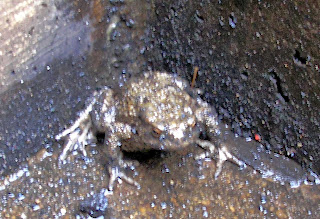
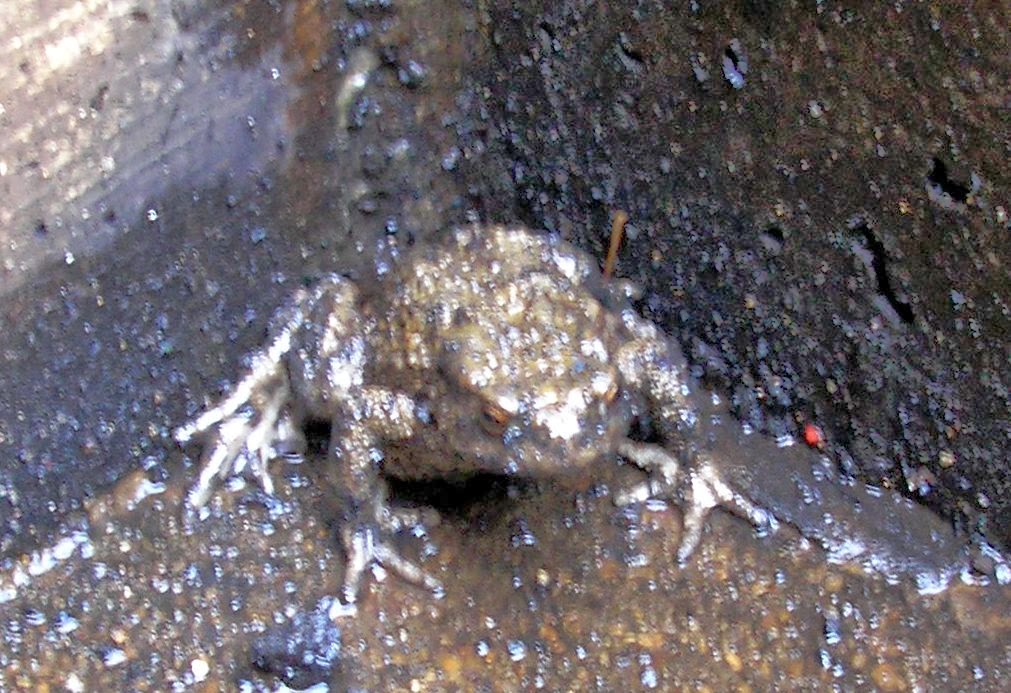
When Bruce was in the pit under the loco, he moved a ladder and discovered a toad hiding behind it. Feeling that the toad was truly in a hole (i.e. it couldn't climb out of the pit), I extricated it and deposited it in the hedge by the wood store - plenty of places for it to crawl and hide.
Removing the piston valves is one of those jobs that requires one to move half of the planet before being able to extract the valve rod. Several sections of running board had to come off. Then, at the rear end of the valve shaft, there is a taper that fits into a slidey-thing. A cotter pin secures the tapered end in the slidey thing, but getting the rod out was a minor challenge. You can't hit the end of the rod to free it. The only thing to do was disconnect it from the connecting rod. The connecting rod is secured to the slidey-thing (aka valve spindle cross-head) also with a tapered gudgeon pin, which has a castellated nut on the inside (not visible in the photo).

It took four of us to remove the pin, separate the parts, slide the valve rod in a bit, and then belt the end of it with a sledge hammer! I was a tad concerned, since it was I who was holding the brass drift against the rod end, while Geof was wielding the sledge hammer - frequently hitting the connecting rod and bouncing into the wheel. But we got there in the end!

During all of the excitement, John G was acting as general assistant and gopher; John T was undoing nuts & things in support of the valve removal. Underneath the loco, Gilbert was removing more bits of the lower ash pan, assisted by David at times, and Ray O'H [Loco Dept] and Andy W, with his gas bottles.
All in all, much fun was had, and many things achieved.
Roger
Gilbert attacked the ash pan, and Bruce initially offered help. The first task was to remove the damper door so that it could be used to verify the new-cut metal. This proved to be quite a challenge. Two chaps from the Loco Dept joined in and helped Gil. Fire bars had to be removed so that Gil could get inside the firebox, standing in the front section, leaning over where the axle passes beneath, and working (almost upside down) in the rear section. It was impossible to undo nuts & bolts, so Gil attacked them with an angle grinder.
The portable lamp threw a wobbly, as two wires decided they'd had enough of being bent. I examined the cable, and discovered that it had not been assembled "cleverly". It was easy enough to cut off the dead wire, thread the cable properly and re-assemble it.
3/4 the way through the last bolt, and Gil's angle grinder died. Raiding the Loco Dept tool store, he found another. Plugged it in ... no sign of life! Why do people put away dead tools, instead of informing someone and getting them fixed??? Gil found a third one, and that did work.
Meanwhile, I started cleaning rail chairs, but rain soon started. This results in the rust & oil combining into a brown soup on the chairs as the needle gun pounds the mixture into a paste. Also, Gilbert had nicked my angle grinder (see above) so I couldn't finish off the prep anyway. As the rain increased, I decided to give up.
Bruce had wisely moved inside and was painting chairs prepared last weekend. He could only spare the morning at Todders, and disappeared at lunchtime. I painted brushes until lunch. Thereafter, there was little I could do, so I went home, too. In a way, it was lucky that I did because a courier arrived at my house with new wire brush discs for us.
Fri. 8th
I did lettering on rail chairs and then dismantled our dead angle grinder. One of the carbon brushes had died. I located spares on t'internet and order a set.
Sat. 9th
Lots of people responded to my email asking for help for Gilbert, as he was supposed to be replacing the lower rear section of the ash pan and remove the cylinder valve pistons - these need to be completed by end November.
Because rain was threatened, I arrived early and attacked some GWR rail chairs, cleaning three before the rain set in leading to me making more soup.
David arrived did a bit of welding. Later, he made a short section of rod for the new position of the damper door. The door will be a couple of inches lower to make it easier to clear out ash. Needless to say, the existing rod then fouled some pipe work, so this by-pass had to be made to divert the rod round the pipe. Bruce, John G, John T, Geof soon followed. Despite the rain, most people started tackling the ash pan and valves. Fortunately, the rain stopped at lunchtime, which made it more pleasant to continue.
The rear damper door (that Gil managed to get off on Wednesday) was bent in the centre of the top edge. Because our ash pan had to be narrower than the original in order to accommodate the steam heating pipe (which was not fitted originally) the cast steel bracing piece from the original damper door had been cut through the middle. This formed a weak point, and the doors tended to bend down the centre line. So, Bruce & John T undid the nuts and bolts, and David subsequently welded up the centre. Meanwhile, Andy W [Loco Dept] got the gas out and tortured the door, beating it back into more-or-less straightness.

When Bruce was in the pit under the loco, he moved a ladder and discovered a toad hiding behind it. Feeling that the toad was truly in a hole (i.e. it couldn't climb out of the pit), I extricated it and deposited it in the hedge by the wood store - plenty of places for it to crawl and hide.
Removing the piston valves is one of those jobs that requires one to move half of the planet before being able to extract the valve rod. Several sections of running board had to come off. Then, at the rear end of the valve shaft, there is a taper that fits into a slidey-thing. A cotter pin secures the tapered end in the slidey thing, but getting the rod out was a minor challenge. You can't hit the end of the rod to free it. The only thing to do was disconnect it from the connecting rod. The connecting rod is secured to the slidey-thing (aka valve spindle cross-head) also with a tapered gudgeon pin, which has a castellated nut on the inside (not visible in the photo).

It took four of us to remove the pin, separate the parts, slide the valve rod in a bit, and then belt the end of it with a sledge hammer! I was a tad concerned, since it was I who was holding the brass drift against the rod end, while Geof was wielding the sledge hammer - frequently hitting the connecting rod and bouncing into the wheel. But we got there in the end!

During all of the excitement, John G was acting as general assistant and gopher; John T was undoing nuts & things in support of the valve removal. Underneath the loco, Gilbert was removing more bits of the lower ash pan, assisted by David at times, and Ray O'H [Loco Dept] and Andy W, with his gas bottles.
All in all, much fun was had, and many things achieved.
Roger
Saturday, 2 November 2013
Maintenance Update
On Wednesday (30 Oct), Gilbert was alone at Toddington, cutting out steel plate to fabricate a new bottom half for the front section of the ash pan.
On Saturday (2 Nov), Gilbert continued, making sure the two side sections were identical in size and shape. He then cut the damper door section (including the hole for the door).
Bruce inspected the "pep" pipe tap, but it seemed to be OK. People will just have to live with the fact that it dribbles. If one of us is around the next time 2807 steams (possibly not until after Christmas) we could test the effect of opening the LHS injector feed side, and then the RHS injector feed side (without the injectors on). Whichever one squirts water out at a significant rate must be the side with the top clack that leaks.
Dodging showers, Bruce and I prepared 9 rail chairs to try to build up boot scraper stocks (we have just two completed ones in stock).
Roger
On Saturday (2 Nov), Gilbert continued, making sure the two side sections were identical in size and shape. He then cut the damper door section (including the hole for the door).
Bruce inspected the "pep" pipe tap, but it seemed to be OK. People will just have to live with the fact that it dribbles. If one of us is around the next time 2807 steams (possibly not until after Christmas) we could test the effect of opening the LHS injector feed side, and then the RHS injector feed side (without the injectors on). Whichever one squirts water out at a significant rate must be the side with the top clack that leaks.
Dodging showers, Bruce and I prepared 9 rail chairs to try to build up boot scraper stocks (we have just two completed ones in stock).
Roger
Subscribe to:
Posts (Atom)