Wednesday, 24 May 2017

Maintenance Update (ashpan, valves, rescue, heat)

Wednesday 17th
Gilbert and Brian arrived and then went off to speak with Graham, who is drawing up the plans for the next ashpan. The current one we had made with hopper doors - sounded a good idea at the time: makes it easy to drop the ash out at the end of the day. It didn’t work; that is to say, it caused more trouble than it was worth and eventually we welded in another floor over the top of it. Also, in practice we overcame a difficulty in raking out ash from the rear section by lowering the floor of that part, thus enabling a rake to get inside and be operated more easily.

When they came back, Gilbert volunteered to clamber inside the firebox to verify some internal dimensions applicable to the ash pan.


The weather today was rain … all day. With 2807 in the shed, Bruce was able to work on the safety valve spacers. The valves lift at about 210 psi instead of the expected 225. Speaking with Carpo, he pointed out that the boiler is pressed for 225 psi which actually means that the pressure must never exceed 225 - it doesn’t mean that she blows off at 225. In fact, it is probably best for the safety valves to lift at about 220 psi. Then even with the blower on and a roaring fire, the valves should prevent pressure rising above 225.


Bruce has calculated that one psi difference is the equivalent of about 3.5 thou’ on the spacers. So, he has taken them off to shave 5 psi’s worth off. We can see what the difference is when she’s next in steam.


Bruce has also modified his design for the guard irons on the back of the tender. The new design has a two-part guard that bolts together. This has the advantage that the lower section can be replaced if, for example, when the tyres wear the guard iron becomes too close to the rails. Carpo gave his blessing to the revised design, so Bruce will now purchase the materials.

I spent most of the day applying the enamel top coat to the boot scrapers in production.

The biggest laugh of the day came from Roy [Loco Dept], who I had been training for fire-lighting. Often you have to clamber into the firebox and get the ash out by lifting a couple of fire bars and raking the ash through into the ash pan. I made a hook for sliding between bars and lifting them up. Roy had found a length of material to make himself one, and he popped in at coffee time to verify that it was suitable. When he departed, he turned the handle on the outside of the van’s door. When we came to leave, we couldn’t get out! The door is of the type with a handle only on the outside. To turn it, you have to lower the window (using a leather strap) and reach outside. However, the windows have been screwed up and can’t be opened! There was no way to open the door or to access the handle to turn it! We were stuck inside! I had to ‘phone a friend’ and ask him to rescue us!!!


Saturday 20th
2807 was next to be in service at the gala (27th - 29th May). However, the connections on Dinmore Manor’s new tender had not been completed in time, and P&O was failed, which left just Foremarke Hall and 2807 to hold the fort over the weekend!

Bill valiantly soldiered on with the restoration of the siphon van at Winchcombe. He was applying bitumen paint to one of the bogies - all on his own! I was on crossing duty at Winchcombe station, but Bruce and John T turned up and were working at Toddington. It was a real ale weekend, and there is a great reluctance to work ... not because of the beer available, but the fact that you have to park in the field and walk down to the yard on event days!

John immediately set-to needle-gunning more rail chairs; Bruce began by investigating remaining issues. Later, Bruce moved on to wire-brushing the chairs and John painted their bottoms.

Graham, on 2807’s footplate, reported that the safety valves are lifting at just before 215 psi. This is with the spacers removed (to be shaved a little) but retaining nuts in their former positions.

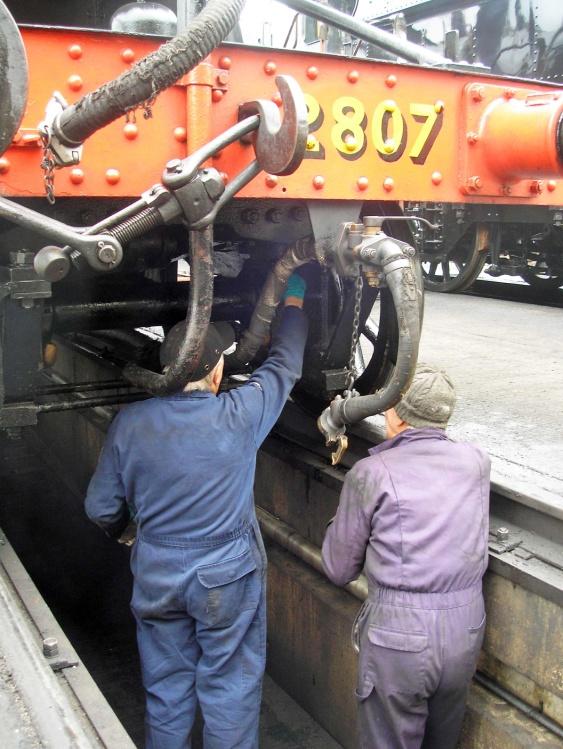
Towards the end of the day, the driver found Bruce and gave him a rubber seal, and asked him to fit it in the front steam heating hose. Bruce had a go, but it was not trivial; he ran out of time.

Monday 22nd
P&O had been fixed and was having a warming fire lit in anticipation of a steam test on Tuesday. Dinmore Manor was back in one piece and being prepared for service this week.

Wednesday 24th
Having shaved off 17 thou, Bruce began by fitting the spacers back onto the safety valves. They are only in temporarily, but the nuts on the top of the spindles are the important ones. If the valves lift at or about 220 psi, they will be fitted fully.


Bruce had another idea - why not replace these spacers with a pair of nuts? Adjusting spacers is a fiddle, and if you shave too much off, then you have to make new ones. There is enough thread on the spindles to accommodate a pair of nuts (locking nuts), and these would be a lot easier to adjust.


Job done, Bruce returned to the steam heating hose. He made a small scraper tool to get the remnants of the old one out of the ridge, and then with the help of several people, Alex (I believe) finally managed to get the new one in place.


Meanwhile, John G was working on the boot scraper production line, applying a first coat to the tops of those that John T & Bruce prepared on Saturday. At the other end of the production line, I was applying gold to the lettering and fitting brushes.

There was the one new issue reported (and cleared):
19: Steam heat bag [i.e. hose] on loco is missing the rubber seal. [q.v.]
Bruce cleared issue 7 which reported safety valves lifting at 215 psi (instead of 225).

Finally, the Cotswold Steam & Wildlife Preservation Group ended the afternoon with a session of rabbit spotting.


This weekend is Gala Weekend. 2807 is due to be in service. Parking is on the field, again. Some of us are on duty elsewhere, so I think we all deserve the day off!


Roger

Saturday, 13 May 2017

Maintenance Update (scoop, tender, stays, tube)

Wednesday 10th
Gilbert popped in, but toddled off to Winchcombe to help Fred on the siphon restoration because there is little to do on 2807.

One new issue has been logged. Here is the list of outstanding issues and their status:
1 J cocks are stuck [A last-year’s issue: Probably in the cab; in ‘open’ position]
2 LH front & rear top mud hole doors & right-hand top blowing [Marked as “Monitor”]
7 Safety valves lift at 215 lbs [We will verify and adjust at next wash-out]
12 RH piston gland packing blowing [This is not a significant leak - Monitor]
18 L/H clack valve/injector steam valve blowing slightly [We’ll take a look when she’s next in steam].

Chaps from the Loco Dept, supervised by Brian, cleaned out the grate and the smokebox. They also cleaned the bottom half of the loco including the motion.


Brian cleaned up the water scoop column because the fracture in the casing became visible again. Bruce re-painted the column.

John G wire-brushed the queue of rail chairs in the boot scraper production line, and Bruce painted their bottoms.


I finished off a load of boot scrapers - painted the lettering on them and fitted the brushes.

Bruce & Brian joined in as Dinmore Manor attempted to weigh their new tender. The usual amusing discrepancies arose: how can it be heavier one side than the other; how come the weights change when you run it up & down the track and weigh it again. 😊

Saturday 13th
2807 is next in service at the gala (27th - 29th May). Today was ‘Lego day’, and with parking on the field plus nothing much to do on 2807, we had the day off.

Well, I did some painting of chairs and cut up a multitude of wooden wedges for the boot scrapers (to hold the brushes in place). Pete and Alex from the Loco dept cleaned 2807’s grate. Pete reported that there appear to be a number of stays weeping; ditto at the corner patches, and one tube could be partially blocked.


Meanwhile, I had done some investigation of the historic report of “J cocks stuck”. I found out which ones … and, yes I couldn’t close them.


Roger

Saturday, 6 May 2017

Maintenance Update (clean, spring, oil, weights)

Wednesday 3rd
At last, the engine stood still long enough for us to address some of the issues!

Brian seemed to be in “management” role, as he supervised Tom, Alex and Gwen who were cleaning various bits on the loco.


Brian also gave a brief report on the recent visit to Llangollen, which is one of the places under consideration for the boiler overhaul in 2020. It was interesting to note that they are already booked up for boiler work until the beginning of 2020! Brian also examined the leaking ash pan sprinkler, where it became apparent that the delivery pipe had sheared where it passes into the ash pan. This may have been the result of expansion/contraction stress.

Gil told me that Tom and Roy from the Loco Dept had cleaned out the drain cocks (which had allegedly stuck at one point last week).

Bruce examined the spring that has been reported as possibly broken. Clive had also taken a look, and it does not appear to be broken, but we will keep an eye on it. Bruce also investigated the alleged oil leak from the pony truck. His view is that it was most likely over-filled, and it is designed to dribble oil down the horn guides, which may have triggered the report. The oil pot was full, and no sign of leakage.


Bruce had another bash (literally) at the balance weights on the driving wheel to make sure they are as tight as is possible.


Also, he’d been calculating the adjustment required on the safety valves to get blow-off closer to the 225 mark (as they currently lift at 210).

Clive replaced the broken spring in the flange lubricator.

John G was painting rail chairs all day: one blue (GER), one red (MR) and eight green.

I was also working on the boot scraper production line for much of the day, apart from assisting PWay with the cutting of some rail for a customer.

Here is the list of issues:
1 J cocks are stuck [A last-year’s issue: We never did find out which J cocks were stuck …
I decided to cross it off unless/until a clearer report is given in the future]
2 LH front & rear top mud hole doors & right-hand top blowing [Marked as “Monitor”]
7 Safety valves lift at 215 lbs [We will verify and adjust at next wash-out]
8 Top front left hand mud hole door weeping [Repeat of 2]
9 Top front right hand mud hole door weeping [Repeat of 2]
12 RH piston gland packing blowing [Gil reckons that this is not a significant leak]
13 LH pony axlebox losing oil but cool at the end of the day [Suspect driver mistaken]
14 Mud hole door RHS of firebox leaking [Repeat of 2]
16 Suspect broken leaf in LH trailing wheel [spring], 3rd or 4th leaf down. [Not broken, but will
monitor]
17 RH trailing flange lubricator spring broken. [Repaired]

Saturday 6th
2807 was on the Fire & Drive on Friday, and continued in service today. Only John T and I were at
Todders, and there was little to do apart from boot scraper production.


Gilbert popped in, but toddled off to Winchcombe to help Fred on the siphon restoration.

Sunday is 2807’s last service until the gala (27th - 29th May). There are no new issues logged.


Roger

Saturday, 29 April 2017

Maintenance Update (numbers, chairs, stops, letters)

Wednesday 26th
Yet again 2807 was in service, and she is rostered to be in service over this weekend. There was a bit of a whoopsie on Sunday! When the locos were parked up at the end of the day, it appears that the rostered engine, Foremarke Hall, was left inside the shed, with the 42xx outside on the same track. When the lighter-uppers arrived on Monday afternoon to do the necessary, there was no one around to drive the shunter and get Foremarke out of the shed! A minor panic ensued, as nor was there any sign of a sheet with people’s contact details on. Eventually, someone was contacted and the decision was taken to run 2807 instead. Apparently, she still had 20 psi on the clock, anyway, from Sunday.

Out of the kindness of my heart, I printed off phone numbers, laminated them and pinned them up in the Ops office and in the mess coach for future reference.

So, back at the ranch today, Bruce, John G and I decided that there was little to do; similarly, there will be even less to do on Saturday. Gilbert & Brian had buzzed off to Llangollen for a chat to them.

There were three rail chairs awaiting wire-brushing (having been needle-gunned by John T last time), so Bruce did the brushing and John G painted their bottoms. I finished off some lettering on chairs in the production line, plus marked up a tool for JC.


Bruce fiddled with the knob on our pillar drill (it has always been the wrong-way-round: you turn it to the anti-clockwise symbol to effect the drilling of holes).

Then we decided to go home. Meanwhile, here is the list of outstanding issues with the loco:
1   J cocks are stuck [A last-year’s issue: We never did find out which J cocks were stuck …]
2   LH front & rear top mud hole doors & right-hand top blowing [Marked as “Monitor”]
7   Safety valves lift at 215 lbs [On Saturday, I checked them and they lifted at 210 psi]
8   Top front left hand mud hole door weeping [Repeat of 2]
9   Top front right hand mud hole door weeping [Repeat of 2]
12 RH piston gland packing blowing
13 LH pony axlebox losing oil but cool at the end of the day
14 Mud hole door RHS of firebox leaking [Repeat of 2]
16 Suspect broken leaf in LH trailing wheel [spring], 3rd or 4th leaf down.
17 RH trailing flange lubricator spring broken.

Saturday 29th
2807 was in service again today, so only John T and I went to play at Todders. Of course, there was little to do but prepare rail chairs. John was needle-gunning, and I was wire-brushing plus painting.

P-Way Rick has been after a Great Eastern boot scraper for years. I have not seen any GER chairs on our track, but managed to acquire one for him this week [thanks, Chris!].


Interestingly, John’s needle-gunning revealed the BSI kite mark on it - something I have not seen on any other chair.

We can also do door stops. This short piece of bullhead rail appears to have the date 1958 on it. See how the running surface has been rolled over by the weight of traffic. This end piece also had roll-over on its end - you can see where I ground it back.


Torquay Mike has ordered this, so I shall paint it, box it and pop it in the post.

JC (of Foremarke Hall) found another painting job for me to do for him. The chaps have constructed a bench on which to rest a valve rod, with the valve head roughly in the middle section. In the near end there goes a hydraulic jack which pushes the valve rod through to move or release the head.


It seems that people are not keen on turning their hand to lettering … except that the painted lettering on our boot scrapers is a bit obvious …


2807 is having a rest now, for a while, so we can tackle the issues list.

There were no new issues today (except that Driver Cliff told me that the drain cocks appeared to stick open at one point. They did right themselves and gave no further problems during the day).


Roger

Wednesday, 19 April 2017

Maintenance Update (bootscrapers, ash, siphon, guard)

Wednesday 19th
Once again 2807 was in service, and she is rostered to be in service over this weekend - the GWSR Wartime event (including a Spitfire in the car park - can’t wait to see it land there!).

So, the team was dedicated to boot scraper production today!

John T needle-gunning


and John G wire-brushing.


Bruce dusting rust off before painting bottoms


and Roger painting the brushes.


Apart from this, Gil & Brian had been to visit Graham, who is a technical drawer, to design the new ash pan. Gil & Brian subsequently popped in to see us at lunch time.

Fred and Bill were at Winchcombe, working on our siphon van.

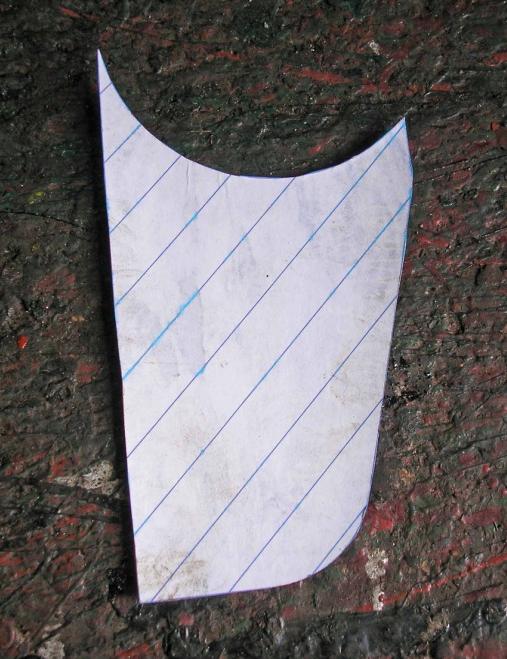
Bruce did hunt for a piece of metal (roughly 1” x 3” x 12”) but couldn’t find any. This is for making the tender guard irons. Here is Bruce’s drawing of the scheme, plus a cut-out for test purposes.


It was decided to cancel the working group’s next planned day (Saturday) because of it being the Wartime Weekend and the fact that 2807 should be in operation again. Hence the reason for this brief report on how we keep ourselves busy when 2807 won’t keep still.


Roger

Saturday, 15 April 2017

Maintenance Update (spacer, drawings, needle, puller)

Wednesday 12th
With 2807 in service, work was thin on the ground. John G painted rail chairs, completing 4 black bottoms and six tops. After lunch he cadged well-deserved a trip on the footplate.


I’m not sure what Bruce was doing, apart from repairing a chisel for me and making extra spacers (of different widths) in anticipation of future damper door problems.

Gilbert was appointed unofficial archivist for the Loco Dept, and spent the day filing diagrams … some in the bin! Such reckless destruction of paper is totally out of keeping for Gilbert. Goodness knows how he managed to get the unwanted drawing to drop off his fingers into the skip!


I’d had an order for rail, fishplates, chairs, etc., from a chap who has a small display in his garden and wants to build an extension. After finding old fishplates and cleaning those, I needle-gunned four more chairs.


Saturday 15th
Only Bruce and I were at Todders - mainly because 2807 was in service; possibly because it was Easter weekend. However, Gilbert and Bill were at Winchcombe, working inside the siphon van. Gil did pop up to have lunch with us. They were hoping to have Richard Johnson (C&W) take a look at the siphon, and in particular recommend an approach to restoring the “concertina” corridor connections.

Bruce and I took it easy, cleaning and painting rail chairs. I had some fun with the needle-gun: It spat
out two of the needles, and began to run slowly. I suspected that the heads of the needles were
inside the piston part, and probably jamming it. So, I took it apart. Anyway, it would benefit from a
couple of new needles. The “new” needles (already second-hand from a dead needle-gun) turned
out to be an inch-and-a-half longer than these ones, so I swapped the whole set (there’s 19 in a set).

Still the gun was on a go-slow, so I took it apart for a second time and discovered that one of the
heads had indeed jammed down the side of the piston, thereby virtually stopping it from moving.
Fixing this and reassembling it, the needle-gun worked rather a lot better! However, it had taken a
chunk of the morning just doing this!

Bruce wire-brushed and applied a primer coat to the chairs in the production line. He then forced me to take a photo of the puller that he and Gilbert had made for removing cylinder covers.

The previous method of persuading a cylinder cover to come off is demonstrated by Brian (below).


The puller is simple enough. You remove the central bolt that holds the cladding to the front of the
cylinder cover. Place the puller against four studs (fit nuts to the studs, if necessary, to ensure they
provide a level surface). Then screw the central bolt through the boss in the puller, and hey-presto!
It pulls the cover away from the cylinder. This is obviously a lot safer than using brute force to break
the seal between the cover and the cylinder block.


If 2807 is given a day off, on Wednesday, we can have a go at fixing the steam leak from the RHS
piston.


Roger

Saturday, 8 April 2017

Maintenance Update (paint, water, Jack, jack)

Wednesday 5th
I spent the day playing with boot scrapers (so, my apologies for things missed or messed up). There was only one left in the F&W, so I had to deliver the three that were ready, and then hastily complete some more to restock the café.

John G was also in painting mode. I believe that he touched up various black bits on the tender frames and the wheels. He then applied black enamel to the RHS cylinder cladding.


It’s a bit annoying how metal particles settle all over the loco, after we’d painted it all, and turn to rust.


I wish people would do their cutting outside or in the workshop, and not in the running shed!

David & Gil dedicated their day to the second damper door. They removed it (with a little help from Brian, I think) and then straightened it up using the press. Bruce made some fresh spacers for the hinges, having discovered that two of the spacers had been made of mesh!

Brian refilled the boiler (it having been drained in anticipation of going to Didcot) and the Loco Dept filled the tender with water.

Now that it was full of water, Bruce measured the height of the tender to see how level it was after our fiddling with the springs. Near enough level. Slightly up at the front (but there’s no coal on yet). He decided not to play any more with the springs!

Bruce had some thoughts about fitting rail guards to the tender rear. However, Carpo joined in, and it is now on Plan C. Plan A had guards attached to the steps (see blue arrows). Plan C has much smaller ones attached to the rear brake hangers (yellow arrow). A bonus is that if they should hit something, the tender brakes will go on!


2807 is currently rostered to be in service from 12th to 17th April inclusive.

Saturday 8th
There’s a bit of a lowatus, really, since we’ve nowhere to go. Bruce and Gilbert we so stuck for
something to do that they even went and helped Dinmore Manor. The Manor chaps were having
trouble getting their cylinder cover off, so B+G made them a puller. It was easy enough to get the
cover off, really; it’s just that it didn’t want to come off.

John T noted the boot scraper stock situation and immediately set to, needle-gunning rail chairs. He
dedicated the entire day to this task, completing 10 by end of play.

I subsequently wire-brushed six of John’s chairs. By this time, Gil was so stuck for something to do
that he volunteered to paint their bottoms black! He’d already painted the cylinder puller in yellow.

Bruce had wandered off looking at the guard irons on the tenders of the other locos. He also took
numerous measurements in order to produce a scale drawing of the proposed solution for our
tender. He’s going to print off the iron (if he’d got a 3D printer, he could print off the whole thing!)
for a test viewing.

This must be visiting season, because on Wednesday we’d had Ken S. and his mate visit for a cuppa, and today we had the granddaughter of Jack Humphries come to see the engine that her granddad had worked on.


This photo, taken by Mark Taft in 1996, shows Gilbert, Bruce and Jack when the frames where being lowered onto the wheels in Toddington yard. The team achieved this major milestone using just brain & brawn - no crane involved: just Jack and a jack!


Roger

Sunday, 2 April 2017

Maintenance Update (wax, loose, copper, Didcot)

Wednesday 29th
With assistance from several Loco depot chaps, the boiler and tender were drained of water and the ash pan emptied of ash.


Brian waxed the remaining lower RHS of the tender, but because of some steam-cleaning that was taking place in the shed, the whole of the tender became covered with condensation! This made polishing an impossibility.

Somebody discovered that the bolts holding the smokebox stays onto the front running board were all loose. Furthermore, because of their round heads it was a challenge too far to tighten them up. So, Gil got a Loco Dept chap to tack weld the heads down!


This ruined John G’s paintwork, so he had to clean up the mess and repaint the bolts.

John had spent the morning painting rail chairs, so was well positioned to touch up the loco.


I applied a top coat to some chairs before having a go at polishing. The cab side wasn’t a great success. That is to say, rather than the dull 7-year-old paint coming up like new, the new (patched up bits) became dulled down to match the old!

So, I gave up and polished copper and brass in the cab instead.


Bruce disappeared before I had chance to find out what he’d been doing!

Saturday 1st April
Disappointing news: the trip to Didcot is off! I quote:
“As you perhaps know we have no road access and rely on rail transport for getting larger items onto site, which includes coal, materials, rubbish (going out) and locos. … we are experiencing tremendous problems in just getting our day to day requirements sorted.

In trying to get 2807 into and back out again is proving really difficult and I may not even have space to off load her onto our “pad” let alone couple her up and move her...

So it is with great regret that I am having to cancel the hire of 2807 for our Gala.”

Bruce reports on the day at Toddington:
“As Saturday was the first day of the Volunteer Recruitment Fair there was not much 'actual' work done. 2807 and Foremarke Hall were on display in the shed and both had been set up with steps to allow access to the footplate. Brian put a light into our firebox so that visitors could see what it was like in there.

Several departments had information tables and Stuart set ours up next to the loco. He then manned it for most of the day, giving out information and selling raffle tickets.

John T spent the morning cutting bolts off some of the rail chairs and John G did some painting on the side of the loco away from the visitors.

The rest of us were busy talking to the visitors and spreading the word about the railway and in particular 2807 and its history.

It was noticeable how interested they were in the exhibits and how readily they entered into conversation with the various departments.

At lunchtime the CSP directors had a board meeting so John T and Bruce manned the stall in Stuart's absence.”


Roger