Saturday, 22 February 2014

Maintenance Update (siphon, tender, bootscrapers, Manor)

Colin provides an update on siphon van restoration:

" Sat 15 - at the Siphon:

We went down to the coach to inspect what the weather had done to the sheets.

I had brought Ann as extra hands in case of any problems, in the event the coverings were ok. I thought we would have no power but Fred had fixed up a lead from a socket nearby so we had another go at the slats as Fred had done some more  work on the post and bit by bit we inserted all 22 slats for the two windows.

Each of the windows have different fittings, one side just slid in with a plain shoulders although they had been painted so we had to fettle each one, the other frame had lugs to fit in holes either side and so we had to fettle these as well as well as checking that they were straight to the eye and fitting into the post holes. very time consuming. finally just one slat was holding out and was 1/8" out but we had to leave then as the dog was at home and must have been crossing his legs. so that is for next time.

Ann meanwhile had been scraping paint off the internal walls - very boring but will look good when finished.

All in all a good day and some progress and no water through the roof but a bit through the holes in the sides.

I would just like to thank Fred for all the work he puts in at the siphon and a lot done at home and without which we would not be going anywhere.

We had fun in the form of coaches being shunted back and forth by an 02 Shunter by C/W guys who admired what we have done so far ."

Weds 19th

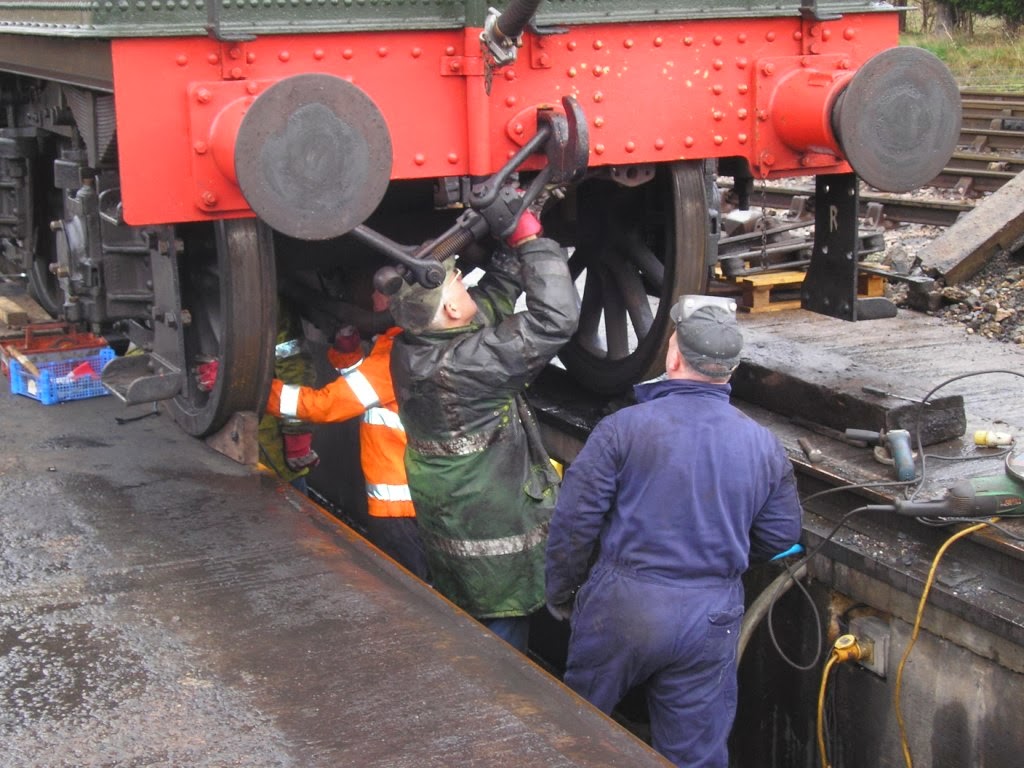
Gil, Dixie and Bruce continued with fitting the brackets, hangers, brake shoes and rigging to the tender.  By end of day, all of the brakes are fitted and fully operational.  Bruce had moved on to making gaskets for the tender's vacuum pipes.

We had anticipated having to push the tender, today, such that the shunter could couple up to the rear and move the tender.  It was planned that on Friday, when Dinmore Manor arrives, our tender will be turned.  This involves it going up onto the lorry; the lorry doing a U-turn in the car park, and dropping the tender off facing the opposite direction.  I was armed with a pinch-bar (a duff one as it turned out) and ready to get the tender rolling, when Mark Y called a halt to it all.  There was some doubt about Dinmore arriving on Friday.  As we need to be over a pit to fit the remaining pieces (vacuum and steam heating pipework), we might as well stay put!

Meanwhile, I'd been working on rail chairs all day.  Painted 16, cleaned a further 3 and sold 2.


Thursday 20th

I nipped down and painted 14 LNWR in enamel black.  Washed the brush out, and then noticed two more hiding!  Went home anyway.

On the way out, discovered that Dinmore Manor had arrived.  I asked Mark (who was shunting her into the shed) if he wanted our tender moving, but he said that the move & turn-around is now to be carried out on Monday.


Friday 21st

Popped in at Winchcombe and discovered a new pile of rail chairs for us.  I picked out 2 LMS, 2 GWR and 2 BR(W), and took them to Todders.

Painted the lettering on the 14 LNWR chairs.


Saturday 22nd

I went via Winchcombe to pick up 6 more rail chairs to take to Todders.  Bruce arrived and we decided to start on finishing the tender.  Gil arrived and we began refitting the vacuum pipes under the tender.  Then Geof arrived, saying that the weather was good enough (just) for him to join in.  So he took over from me, and I went back to chair painting.


The chaps fitted the vacuum pipes (two of them) and started on the steam heating pipes.  But this could not be completed because we need David to do some welding where we had to cut the pipe free to take it off.

Steve was around, and did chip in when it was time to move the tender.  We had to push the tender (by hand, as it were) along past the points, so that the 08 shunter could couple up to the rear of the tender and take it round into the yard.  Steve & Geof demonstrated how to push the tender [not], with Bruce acting as brakeman.


The shunter deposited the tender in the yard, with Geof applying the handbrake.


Roger

Saturday, 15 February 2014

Maintenance Update

Saturday 8th - update

Colin sent photos of the siphon - you can see the slats and the general state of repair before Fred's restoration group get at it.  It's a long haul going all the way round it!


Colin adds:

"Went down to help on the Siphon Sat 7 We first fixed the light which had not worked for a long time. We then tried the slats for the windows in the new post Fred had made they were quite a way out so we took the post off again and moved it up a bit and the slats looked great we were just  thinking what to do next when Carriage and Wagon guys came and could we be ready to move in an hour ok so we strapped everything down and within the time frame the coach was moved it was quite strange to see the steps still there with no coach we spent the rest of the day tying down the sheeting in a gale force wind then I took Fred and some chairs down to Toddington quite a day!.

Attached are some phone photos of the move. I have some more and Fred took some as well

The only thing we forgot to secure in the move was the table  with the Microwave on it on castors so it went walkabout no damage done."


Weds 12th

Bruce & Gilbert began by playing with the tender - Bruce attempted to open up the hole in the frame for the final pin to pass through horizontally.  He gave up.  The driving wind & rain were just too much.  However, this is the last one to be done.

Talking of bolts (which we almost were), Gil bought two different lengths (because of two different thicknesses of plate to pass through) and the shorter ones were fully threaded.  The longer ones are only part threaded and have an unthreaded portion inside the bracket casting and supporting cross-member. Indeed Bruce is having to extend some of the threads otherwise the threads will not even reach through.  The railway is not happy about us using the fully threaded bolts.  Mark Y came and discussed the situation with Gil & Bruce.  Gil explained that it is not possible to buy what the Railway say, off-the-shelf.  Mark Y stated that if such is the case, then the Railway (workshop) will do whatever is necessary to form bolts to the Railway's specification .. as a priority!  Mark Y (and Carpo) also confirmed that using the R-clips rather than split pins is acceptable to the Railway.  Gil has gone away with a new shopping list!

Anyway, Bruce continued to extend threads and drill holes for R-clips on those bolts that are acceptable.

Being consigned to inside the TPO due to the weather, Dixie began sorting through model railway bric-a-brac with a view to rationalising the stock.  I "rationalised" some boxes of "Admin" stuff … except that Gil stopped me from donating the projector and set of slides to the skip.  Goodness knows when they were last used for a talk.  They might just go walkies when Gil's not around.   ;-)

Just after tea break, we had a power loss.  Dixie went to investigate (him being an electrician) and it was the whole site dead.  Lucky it was after tea break!  It did occur to me that if the power was off for an extended period, we were stuck there because the gate wouldn't have opened!

After 15 minutes, the Grand Universal Provided let there be light, and we pressed on.  Dixie and I painted rail chairs.  Dixie had the pleasure of doing six black bottoms, three black tops and 3 GNR green.  I did lettering on 3; 4 BR(W) green top coats plus 2 BR(W) red undercoats.

The sun began to shine at 3 o'clock, but we went home anyway.  As we left the yard, a wheelbarrow was hurtling in an easterly direction, all on its own.  As it was heading for our tender, I though it prudent to chase after it and return it to the wheelbarrow stable .. and make it stable.  We had discussed pushing the tender close up to the workshop door in case that made it less likely to go ride-about on its own.  But we didn't bother.

Oh, and The Railway agreed that we can have 2807 facing south when she comes back.  This will mean also turning the tender around, of course, otherwise it would be a struggle for the fireman to get at the coal!


Saturday 15th

Gilbert, Bruce & David pressed on with the tender.  It's amazing how much time it is taking to get these bolts done to spec.  Bruce spent most of the day lining up each individual bolt in his jig and drilling the hole through it for the split pin.  David spent much of the day with a die, cutting the thread just about three more turns on each bolt.  Gil was under the tender.  Mike [Loco Dept] joined him after lunch, and they worked on fitting the brackets, the hangers and the brake shoes.  The front pair are completed and functional (so the tender won't blow away).  The rear ones are fitted but not yet functional because they need the operating rod fitting that connects all of the brakes.  The centre pair are not yet fitted.

Next Weds we need to fit the centre ones, and get the whole brake system functional.  Reason?  Because next Friday the railway is going to turn our tender round … when Dinmore Manor arrives. 

Back to today:  Mike refilled the axle boxes with oil.  They didn't need a changing particularly, but Bruce had drained them when the thought was that we would need to jack the tender up to carry out this work on the brakes and that meant that the underkeeps would have to be removed .. whereupon the oil would escape on its own.

I pressed on with chair cleaning.  I have been sorting out pre-World War One chairs to do a special one-off offer for the May gala (all because of the WWI theme).  Being 100+ years old, these chairs are generally a tad filthy.  See attached before & after photos.  They'll get a couple of coats of paint and the lettering will be picked out, of course. 


I found some GWR in addition to the GNR and LNWR ones.  Having exhausted the supply of these oldies, I had the usual delight of painting their black bottoms and black holes.


Roger

Sunday, 9 February 2014

Maintenance Update

Monday 3rd
Following complaints about the state of our files and the wearing out of all of our metal saw blades, I bought some more NEW items!!!  The chaps will be thinking it's their birthday!

Wednesday 5th
Foul weather - strong winds & driving rain.  Hardly fit for working outside.  Nevertheless, Gilbert did venture out to the tender.  The pit over which it is standing was filling up with water, and the pump had seized.  Bruce said the only thing to do was stand on a sleeper rather than in the water.  Gil removed the front two brake hanger brackets so that Bruce would fit bolts in the warm & dry TPO, and drill the bolts for a split pin.

While it was not raining hard, Gil also cleaned the tie bars, links and brake hangers ready for refitting them.  Mike also assisted Gil.


Each bracket has to be fitted with its bolts and they are drilled to take a split pin as close to the nut as possible.  Minor differences in the brackets necessitate this action individually.  Bruce was doing this all day.

Having built up a stock of cleaned rail chairs (in anticipation of such a day) I was able to paint 9 black bottoms, 3 Darlington Green GNR 1913, 4 BR(W); do lettering on 3 crimson ones, and fit 14 painted chairs with their brushes. 

JC had delivered our new blow-down valve.  This is a bit of a sore point, because we had one of these; were advised to get an "Everlasting Blow-Down Valve" instead; and we sold our GWR one.  Now the railway has insisted that we get the Everlasting one replaced with a GWR one.  The problem was that the Everlasting valve did not match the face on the boiler, hence a joining section had to be fabricated … and it corroded.  Bad news, because a failure in that would emit water at maybe 300 degrees C, just below the cab.


Saturday 8th
David, Bruce and Gil continued working on the tender brakes.  By rain-stopped-play, the front two brackets were completed, pins secured, hangers hanging, tie-bar tying the two hangers together and brake blocks fitted.  Bruce applied the tender handbrake, just to get the brakes to go on this one axle - it'll stop the tender from blowing away!


Gil disappeared to an FLA meeting after lunch, while Bruce and David attacked the rear two brackets.  As usual, two out of three holes aligned perfectly.

David also marked a template for the securing holes on the pony truck bearing cover (AKA bell housing; AKA policeman's helmet) ready to machine the new one to fit.

Steve popped in for a cuppa and a biscuit before attending the FLA meeting.

While it was dry (cold and blowy, but not raining) I tackled some more disgustingly filthy rail chairs.  These are all pre-WWI that we plan on selling without brushes at suitably themed events.  I was just de-greasing the 7th one when the rain set in.

At Tyseley:
The centre wheels have been dropped for the horn guides to be examined.


Roger

Sunday, 2 February 2014

Maintenance Update

Wednesday 29 Jan
Gil, Bruce Dixie & myself today.  The latter being devoted to boot scrapering, while the rest attended the tender.

Gil b(r)ought some NEW bolts for attaching the brake hanger brackets to the frame cross-members.  Guess how much this box of 3/4 inch x 3 inch Whitworth nuts bolts washers & split pins cost?  Answer at the bottom of the post!


The chaps were aligning the brackets and suspension pins of the front two brake hangers on the tender.  Getting the bracket in place such that the brake hanger suspension pin was horizontal proved a challenge.  Clearly, they had not been horizontal before!  The pin has to be horizontal for the hanger to dangle vertically.  There's not much movement in fixing the bracket, but just enough to do the aligning.  Then guess what?  The pin wouldn't go through its hole in the tender frame.  You can argue that they must have done originally, so ... ???  Well, maybe the brackets are not in their original sequence?  In any case, there are at least two different patterns to the hanger brackets!  In fact, two of them had to have one edge gently angle-ground back slightly, to enable it to fit in place at all.  Otherwise it was being fouled by an angle on the tender frame.  Also, two of the (NEW!!!) bolts had to have their heads "modified" for them to fit within the space where this angle is otherwise fouling them.

A couple of weeks back, (note the carefully chosen text:) "it was decided" that the tender would have to be jacked up in order to gain access to these hanger brackets.  Jacks were put in place at the front.  The horn ties (i.e. bars across the bottom of the bit in which the axle boxes rise & fall) were removed from the front two wheel sets to allow the wheels to drop.  Of course, when we set to and began to remove the hanger brackets (was that Bruce & me? I quite forget!) we didn't need to jack up the tender at all.  So, the horn ties were fitted back on today ... except that Dixie came into the TPO just as we were packing away, declaring that someone had put the bolts in the wrong way round!

I was oblivious to all of this fun that the chaps were having.  I was cleaning up three absolutely caked-with-mud GNR 1913 rail chairs until the rain set in, and then I painted nine tops (3 red ready for Crimson Lake; 3 black; and 3 grass green ready for Darlington Green).

Saturday 1 Feb
Bruce procured a set of hole punches for us, as we are forever making gaskets and never have the right tool for the job.  Two lots of new things in one week!  Wow!


Gil & John busied themselves with fitting the brackets on the centre.  Again, this meant quite a bit of fiddling to get the bracket lined up, the suspender pin horizontal and the holes all in line.  Some fettling of the holes through the frame was inevitable.

Bruce made a jig for drilling a hole through each bolt into which an R-clip will be fitted to prevent the nut from falling off if ever it should work loose.


  To get the hole spot-on, Bruce used a piece of plate the same thickness as the cross-member to which the bracket is bolted; used a spacer to represent a spring washer; assembled the plate, bracket, washer and bolt, and then drilled through the bolt immediately behind the nut.  This should be tight up to the nut, so that it can't work very loose even if it tries to!  To finish each off to look neat and tidy, Bruce tried cutting off the excess thread ... but only managed to do one before knackering the saw blade.  He's going to use the angle-grinder next time.


I braved the cold and wind to continue cleaning rail chairs.  My needle-gun froze up*.  Found an LNWR chair dating from 1896.

Next Weds we need to clean the brake hangers so that we can start to assemble each of them (properly - with the correct bolts and R-clips).

* The air expands as it operates the needles and in doing so cools down (I thought it might be Boyle's Law, appropriately, but it turns out to be Gay-Lussac's Law (boring)).  Due to the outside air temperature being only 3 degrees, water vapour in the compressed air was freezing as it coughed out of the needle-gun.

Info from Fred re. our Siphon van:
"I have been informed by Richard Johnson that the C& W dept. can take our Siphon into the barn for re-roofing on March 1st.

However as they are moving stock around in a fortnight's time we will have to be ready to move to a new outside location prior to that.

We will obviously have help in the re-roofing as the siphon cannot be in the barn for too long.

We have requested that we do not return to our present spot which is increasingly impinging on the S&T area as we progress down the length of the carriage so we will probably swap places with the coach behind us on the same track.  Power will still be available  via our existing cable.  We will now have to purchase some white masonry paint asap to go with the adhesive and canvas we have in hand.  Help in making edge securing strips has also been offered by C& W.

We will obviously need a reasonable team of workers at that time.

Things are looking up.

Fred"


================

Answer to bolts: A total of 18 bolts, with nuts, spring washers and 25 split pins came to £109.76p


Roger

Saturday, 25 January 2014

Maintenance Update

Wednesday 22nd
Fred and Ray were working on the Siphon van restoration at Winchcombe; Bruce and I worked on the tender at Todders.

Bruce was already cogitating on the tender brake hanger brackets when I arrived.  The one removed last Saturday had different sized holes [i.e. larger] in the hanger bracket to those in the cross-member to which it was bolted.  Hence the bolts used were really too small for the bracket.  Much discussion took place (with several people) and consumed half of the morning!


Meanwhile, I repaired our heater (both elements had died).  Then I painted some brushes for boot scrapers.  And it was probably time for a cuppa by then!

We decided to remove the other five brackets and see what the state is with those.  We managed to get them off, but access up between the frames is not easy.  In fact, one bolt on the right rear bracket fought hard not to be removed, even though we had managed to extract its nut.  It was apparent that it could only have been inserted in the first place by injudicious use of a persuader!  The holes in the bracket and cross-member where out of alignment!


Two of the brackets had had a washer inserted between the bracket and cross-member, apparently to act as a spacer!  The rear two had had proper spacers fitted and welded into position.  This was all to do with there not being quite enough room for the bracket, because of the angle iron to which the cross-member is attached. [If you can't picture it, don't worry!]

I reamed out the errant holes in the rear right.  Bruce & I then decided on the style of new bolts that need to have a spring washer plus split pin in their ends.

Alan Richards called in (all the way from Brecon) to buy a boot scraper.  We were not mean enough to tell him that we needed his help beneath the tender :-)

JC popped in to collect two half-inch bolts for the blow-down valve that he is finishing for us.  This will be ready for testing at the weekend.

Two tins of bitumen paint had been marked for our use inside the tender coal space.  One had already gone walkabout by Wednesday!  I collected two and showed them the way to our TPO.

Saturday 25th
Only Me, Bruce & Gil here today.

There was quite a bit of talking about spanners and hole-cutters; nuts bolts and holes.  So, what was physically achieved does not necessarily imply that little work was done!  Bruce & Gil drilled two holes.

OK, OK, so the holes were not exactly easy to access, and it was important to get the two sets of holes aligned such that the brake hanger pin was horizontal before reaming out the two holes together.  It transpired that on the front LHS, the three holes for the pin (one through the tender frame and two through the brake hanger bracket) were not holding the pin quite horizontally.  So, the hole through the frame will have to be opened up very slightly.

Bruce & Gil then fitted the front RHS hanger bracket, too.

Meanwhile, I decided to get back to rail chair cleaning and building up the stock of boot scrapers.  By the time the rain came (10 past 3) I had cleaned 5, of which two were extremely caked in solidified clay and/or thick solidified grease.  By chance, my wire brush (a wheel-type, attached to a drill) was expired, and I had just gone into the TPO to get a new one, and the heavens opened!  Apparently, the gale force wind was driving the rain straight past Gilbert, as he worked at wheel height on the right side of the tender (literally the RHS); but straight beneath the tender into the pit where Bruce was standing.  Even though the water level was steadily rising in the pit, Bruce struggled on manfully.

Blissfully unaware of the other two, I began painting rail chairs inside the lovely warm TPO - particularly warm since I repaired the halogen heater.  By end of play I had painted ten bottoms and three tops.


Roger

Sunday, 19 January 2014

Maintenance Update

Monday 13th
Apparently, the tractors and trailers were all in the wrong places on Monday morning, and it took Alleleys ages to shunt them into their right combinations before they could set off for Toddington.  As a consequence, they didn't arrive until 2 o'clock.
Fortunately, I gave up waiting at 11 o'clock and went back home - there was no word from them at that time (despite Gilbert ringing them).

Gil reported on Monday:
"I called in at Tyseley to re-assure them that the loco was coming.
I saw Bob Meanley and spoke to him about the need to keep to the agreed timescale, and that any delays could have a serious effect on our contract with GWSR.
I have emphasised the fact that we must be notified of any problems that occur and which can effect either time or cost. I have also said that we will work with them to solve any problems which are identified. Bob has said that is also his preference.
Once the loco actually arrives, and they are able to get a couple of wheel-sets out, he will ring us so that we can go up to Tyseley, and see what they have found."

Geof reported on Tuesday:
"I supervised the loading of the loco and it left Todders at 16.30 yesterday, stayed overnight at Allerley’s yard and was delivered and offloaded at Tyesley at 0745 today supervised by Dixie Dean."

Wednesday 15th
2874 was just being off-loaded at Toddington as I arrived.  It brought back (horrible) memories!  However, 2874 is in a far worse state than 2807 was when she arrived at Toddington back in 1981.  In fact, if it were mine, I would sell it all for scrap apart from the boiler; that does look restorable.


Anyway, Geof, Gil, Bruce, Dixie and Mike [Loco Dept] were all swearing underneath our tender, as they attempted to remove pipes and rods.  The purpose is to gain access to the bracket & bolts at the top of the brake hangers.  

By end of play all of the brakes were off - shoes and hangers; also the longitudinal operating rods.  The vacuum pipes were off, and the steam pipes were "loose".  All of this, apparently, so that the tender can be jacked up and let the wheels drop so that the holes can be accessed and bolts replaced (see Saturday).

Dixie had forgotten where the hard lumpy bits are beneath the tender, and located one using his head.  This led to a trip to the First Aider, who equipped Dixie with a turban.  The First Aider obviously recommended seeing a Second Aider, so Bruce drove Dixie to Winchcombe Medical Centre.  There they put the skin back in place, glued it down and stapled it together.  He returned to Todders wearing a kippah, no not a kipper! (look it up).  Anyway, after a cup of tea he was fine, and we let him go home.

I seized the opportunity to do some boot scraper work: painted 9 in GWR green top coat while it was raining, then cleaned up 4 chairs when the sun shone.

Saturday 18th
Gil, Bruce, John T and Dixie were working on the tender ... well, under the tender!  Removing the steam heating pipe.  It transpired that another group (who once borrowed our tender) finished off some bits for us.  In this instance, by welding a bracket to the rear section of steam heating pipe, and then welding the bracket to the drag box.  So, the only way to get the pipe off was to cut through it with an angle grinder.


The next task was to raise the tender body sufficient to allow access to the brackets from which the brake hangers are suspended.  These we had fitted many moons ago before the tender tank was fitted onto its chassis.  It was easy to fit them from above; not so easy to remove them from below!  It is the bolts that secure this bracket to the chassis that GWSR insist must have a spring washer and split pin through them (to ensure their nuts cannot drop off).  The bolts are not long enough to do that, so we have to make/procure new ones.  The top bolt of the three has a slotted countersunk head.  Bruce had to make a "screwdriver" to fit the slot and stop the bolt from turning.


I busied myself painting the lettering on boot scrapers; boxing them up, and then making some wedges for fitting the brushes.


Roger

Monday, 13 January 2014

Photos from Saturday 11th - 2807 to Tyseley

Here are a few photos taken on Saturday 11th.


2807 being shunted towards the loading / unloading road.


Standing on the loading / unloading road.


Separated from the tender.


The tender is 'shunted', by hand, onto a pit for some TLC.


The remaining coal is removed.


Awaiting departure.


Meanwhile, here is the new regulator.


Steve

Sunday, 12 January 2014

Maintenance Update

Sun 5th
I popped down for 5 mins, and there a poor lonely soul called Paul, from Brierley Hill, who had come to work in the steam loco dept.  The only problem was, there was absolutely no one there!  Well, we did discover that Tina was in the mess coach, cleaning up.  So, I stayed a while and set him (and me) on barrowing ballast into the puddles to make a land bridge through the lakes from the TPO to the loco shed.

Mon 6th
I spent an hour or two cleaning the tools that we'd used last Saturday.  They were filthy, mainly because of the grot beneath the loco and the puddles through which the extension cables had run.  I discovered that the big socket set box has got numbers (sizes) on it next to the socket holes ... and the sockets have corresponding numbers on them, too !!!  There are 3 sizes missing and two extra sockets that didn't come from this set.  The Draper spanners are all there (I think) though the roll that held them was so disgusting that I consigned it to the landfill bin.

Weds 8th
There was an excellent turn-out today, and a substantial amount of the remaining work was completed - helped by being inside the loco shed!

When I arrived (after the Tesco run) Geof was removing brake blocks, with the assistance of Dixie [Roger Dean] and Mike [Loco Dept].  These were covered in filthy grease [not the chaps, the bake blocks!  ... no, the chaps, too!!!), and the split pins retaining the blocks' pivot pins proved rather obstinate.  By lunch time, they had finished the RHS.  After lunch I joined them, and we removed the RHS brake blocks, which (luckily for me) had R-clips instead of split pins; these simply pull out ... I say "simply" ...

Gil & David spent most of the time between the frames removing the RHS internal motion parts and the expansion link.  This took them right up to 3.30, at which time the rain had set in outside, and other Loco Dept chaps working out there decided to pack in.

Dixie removed the operating rod that works the vacuum pump, though one bolt made a dash for it on the floor, and managed to escape.

At one point, the position of the coupling rods prevented Dixie from removing said nut, and also prevented Geof et al from accessing the brake block pins, so we had to move the loco by hand - it only took 3 of us with "pinch-bars" to move her back about 2 feet.

Oh, back to "when I arrived": since everyone seemed busy, I put the kettle on!  After a cuppa, I volunteered to get inside the firebox to remove the fire bars.  The two fusible plugs were still in the top of the firebox, and I was privileged to be permitted to remove these, though Carpo [Loco Dept's "Boiler Responsible Person"] did keep an eye on me while pretending to hold the torch!  Getting the fire bars out of the grate is a two-man job - one to lift each bar and pass it through the fire-hole door, while a second person needs to grab it and move it to somewhere safe.  In this case, Pete [Loco Dept] was the catcher, and he then passed each out of the cab to Bruce, who was stacking them neatly at the side of the shed.  The grate has to be out so that the boiler inspector can inspect all of the rivets round the foundation ring.

After lunch, Pete was forced (by Carpo) to dismantle the gauge frame (as a training exercise).  Carpo said, 'If you're on the footplate and the gauge glass breaks ...', striking said glass violently with a spanner, 'there's a cloud of steam.  What do you do?'  Luckily, Pete only had to imagine the cloud of steam, of course.

Sat 11th
Loco Dept pulled 2807 out of the shed over the pit.  I had bought some Denso tape, which David & John T used to wrap round the eccentrics to protect the bearing surfaces from rusting.  Aided by Gilbert, David & John then began to remove the one remaining linkage – the drain cocks operating rod.

Bruce removed the delivery pipes from the front sand boxes (which could also only be done from beneath.

Bruce and I then tackled the rubber hoses between loco and tender, disconnecting them at the loco side, and at the same time removing the securing pins from the two auxiliary coupling bars, such that only the main one remained in situ.


Geof began to steam clean the drain cocks rod and sand pipes.  Afterwards, he carried the brass bonnet from the shed into the TPO for safety (and in the hopes that someone (i.e. me) will clean it).

Stu arrived and prepared some boxes ready for holding boot scrapers.  Thereafter, he acted as Tea Lady and Washer-up.

Bruce and John moved on to hopefully resolving a vacuum leak issue.  We have had reports of rapid vacuum loss under certain conditions.  This led to the inspection, dismantling, remantling and head scratching about components in the system (most notably the vacuum relief valve).  However, Bruce figured that a leak in the packing around the vacuum cylinder piston could explain the issue.  Bruce and I released the necessary bolts, and then after lunch Bruce and John T fitted fresh packing.  Here’s hoping!

By lunchtime, John G, Steve and Ingo all turned up to help.

Geof initially set John G on cleaning out the remaining 5 or 6 blocked tubes, but they gave up, because I had removed the fire grate, so Geof couldn’t get on top of the brick arch to access the tube ends in the firebox!  However, John G was then set on to cleaning out the smokebox.  This turned out to be much filthier than at first looked – much muck was hiding in obscure places.  In fact, John was still cleaning up outside the smokebox by the time the loco had been shunted out into the car park at the end of the day!

Meanwhile, Geof drained the water out of the glasses in the hydrostatic lubricator, to avoid ice damage.

Since there was little more to do, I set to cleaning rail chairs.  I completed 5 by end of play.


Ben [Loco Dept] fired up the 08 shunter and hauled 2807 off the pit, round the yard, down the loading line and into the car park, ready for Allelys to collect her on Monday morning.  Gil, David, John T and Ingo were all involved in parting the loco and tender.


Then Ben moved the tender round to the old pit by the coal staithe.  Because of the track layout, the shunter had to abandon the tender such that points could be switched and the tender moved by hand over the old pit.


Once there, the remaining coal in the tender was shovelled out into the JCB’s bucket, so that we can clean and paint the tender coal space.

David examined the old bell cover and the new one, and will take the new one home to finish off.  It needs a lubrication hole in the top, and its “skirt” needs shortening by about ½”.  Temporarily, a bucket is being used to protect the pony truck bearing.


Roger.